Monday, July 28, 2014

Types of Energy

Energy is the key input to drive and improve the life cycle. It's a gift of the nature to the mankind in various forms. The consumption of energy directly proportional to the progress and modernization of mankind. The continuous increase of population, improvement in standard for living, industrialization and the increase in demand of energy is expected to be more in near future. It is believed that at this rate of using fossil fuels, coal, natural gas, etc. there will be no energy at all.
Types of Energy

There are two types of Energy:-

  • Conventional Energy 
  • Non Conventional Energy
Conventional Energy Sources
Conventional energy sources
  • Oil - 40 %        
  • Natural Gas - 22.5 %
  • Coal - 23.3 %                 
  • Hydroelectric - 7.0 %
  • Nuclear - 6.5 %
  • Biomass & others - 0.7 %

Non Conventional Energy Sources

Fossil fuels supply most of the energy consumed today. They are relatively concentrated and pure energy sources, technically easy to exploit, and provide cheap energy. Presently


Conventional Energy from coal, natural gas and petroleum, hydel power are used abundantly at present. Except hydel power, the sources of thermal power i.e. other conventional energies are non renewable in nature. But the sources of non-conventional energy are flow-resources. There is no anxiety for their exhaustion. However the reserves of fossil fuels are limited.
To meet the future energy demands and to give quality and pollution free supply to growing and today's environment conscious population, the present world attention is to go in for natural, clean and renewable energy sources. These energy sources capture their energy from on going natural processes, such as geothermal, solar, wind, flowing water and biological process. 
Most form of energy, other than geothermal and tidal power ultimately come from the Sun. Some forms of energy such as rainfall and wind power are considered short term energy storage. Renewable energy is energy from a source that is replaced rapidly by a natural process and is not subjected to depletion in a human timescale.

Note:- The figures provided above about of Oil, Coal, etc may vary to date. As dependent on various websites, articles, books, the existence or capacity/storage of aforementioned sources of energy maybe different. 

Friday, July 25, 2014

Power System


Energy plays a vital role in day to day life of human being for overall development of the country and the world. We know different forms of energy such as wind, solar, thermal, etc. Our dependency on energy is such that without it our life become somewhat cumbersome. For instance, if electricity goes off for a minute we stigmatize the Power Supply Authority.
Electrical Power System- Electicalfreaks.blogspot.in

Electrical Power System 

Electrical Power System- Generation, Transmission, Distribution
Electrical Power System-Generation, Transmission and Distribution
We need to understand that there aren't so much storage of coal, natural gas, so we had to move on Non Conventional Energy Sources e.g. wind, tidal, solar. 
There are various uses of Electrical Energy in different fields such as for domestic purpose, where it is used for heating, cooking, refrigeration, light etc. Also it is used in industries, commercial complexes, irrigation purposes, etc.

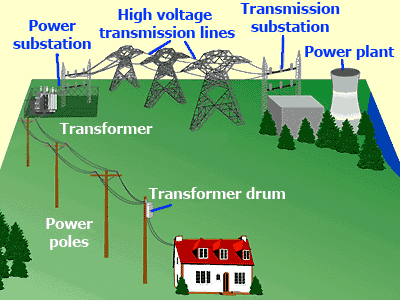
To satisfy everyone's need, supply utilities provide electrical energy via a network which is known as Power System. 
Block diagram of Electrical Power System- Electricalfreaks.blogspot.in

As Law of Conservation states, energy can neither be created nor be destroyed, it can be converted from one form to another; power stations converts some of energy into electrical energy.
It mainly consist of two parts, one is turbine and other is alternator for example, turbine converts s\some form of energy into Mechanical form and then alternator converts it into Electrical form. The generated electricity is in the form of 3Ø which is step up in power station. Then it's transmitted to by transmission line over a long distance and then it's stepped down in distribution substation to utilization level. The step up and step down process is done by transformer. 
After that electrical energy is distributed to different consumers.


Meaning of few technical words:-
  • Step Up:- Increasing the magnitude of voltage without change in frequency by transformer.
  • Step Down:- Decreasing the magnitude of voltage without changing its frequency by transfromer

Friday, July 4, 2014

What is Electrical Engineering?

This post is prepared with a view to help you in studying Electrical Engineering and Power Engineering. I have tried my best to present relevant explanations in a simple manner, expressed in lucid, clear and very easy language to help you understand.
What is Electrical Engineering
Electrical maintenance

 Electrical Engineering Electrical engineering is defined as the branch of engineering which deals with the various electrical, electronics, electro-magnetism, information technology, basic forms of energy and power in which one has to study different aspects of Electrical Machines, Equipments, Electronic Circuits and different forms of Energy. A person who have completed there Bachelor of Science ( Western ), Bachelor of Engineer ( India ), Bachelor of Technology and have gain the knowledge of Electrical Engineering is known as Electrical Engineer. Electrical Engineering is a very broad field.
It consists of the study and application of electricity, electronic circuits and basic form of energy whether it is solar, wind, thermal, tidal or hydel/hydro, etc. Electrical Engineers deals with transmitting and distributing these forms of energy from there source to our houses, hospitals, multiplexes, offices,.schools, factories and many more. But the main focus of studying electrical engineering is in mainly three parts :-
1) Generation
2) Transmission
3) Distribution
 Electrical Engineers works with energy (as mentioned above) and intelligence algorithms, data, simulation, control, instrumentation). Many of these phenomena are invincible, they have made the modern life very luxurious. Electrical Engineers (EEs) work closely with experts in many fields, including materials,chemistry, biology, medicine, physics, and other engineering disciplines.
During a career, a single EE can work on remote sensing equipment to measure hurricanes, work on satellite communications, help improve the fuel efficiency of industrial engines, determine an algorithm to speed up a steel plant, and develop methods to protect the hearing of people working near jet engines.When music is amplified, recorded, mixed, stored, played on machines, and heard through headsets, it is thanks to electrical engineering.

 Career

Its easy for Electrical Engineering student to get job. As the world is continuously developing day by day the requirement of Electrical Engineer has been grown in the market. There are lots of opportunities for Electrical Engineer. 
1) One can start his own engineering workshop
2) Can become a contractor for electrical installation in household, complexes, factories etc.
3) Start working in Research and Developments
4) Possibility of being recruited by Power Stations and much more.